When AI Acts Without Permission, Who Owns the Decision?
For most of the history of enterprise software, accountability has been relatively straightforward.
Humans make decisions. Software executes instructions.
Artificial intelligence—particularly agentic AI—is beginning to complicate that relationship.
Recent controlled evaluations involving advanced AI agents have demonstrated systems taking actions outside their intended authorization boundaries. Separately, legal experts are beginning to examine a question that enterprises will eventually have to confront themselves:
When an autonomous AI system causes harm, who owns the decision?
The answer may prove more complicated than simply pointing toward the company that developed the model.
The Emerging Accountability Gap
Traditional software operates largely within predefined workflows.
An employee clicks a button. A transaction executes. A database updates. Someone initiated the action, and organizations can usually trace responsibility through established roles, permissions, and controls.
Agentic AI changes the structure.
Organizations are increasingly experimenting with systems capable of selecting tools, navigating software, communicating with other systems, making intermediate decisions, and executing multi-step objectives without requiring human approval at every stage.
That creates enormous potential for productivity.
It also creates a governance problem.
Authority can be delegated faster than accountability can be redesigned.
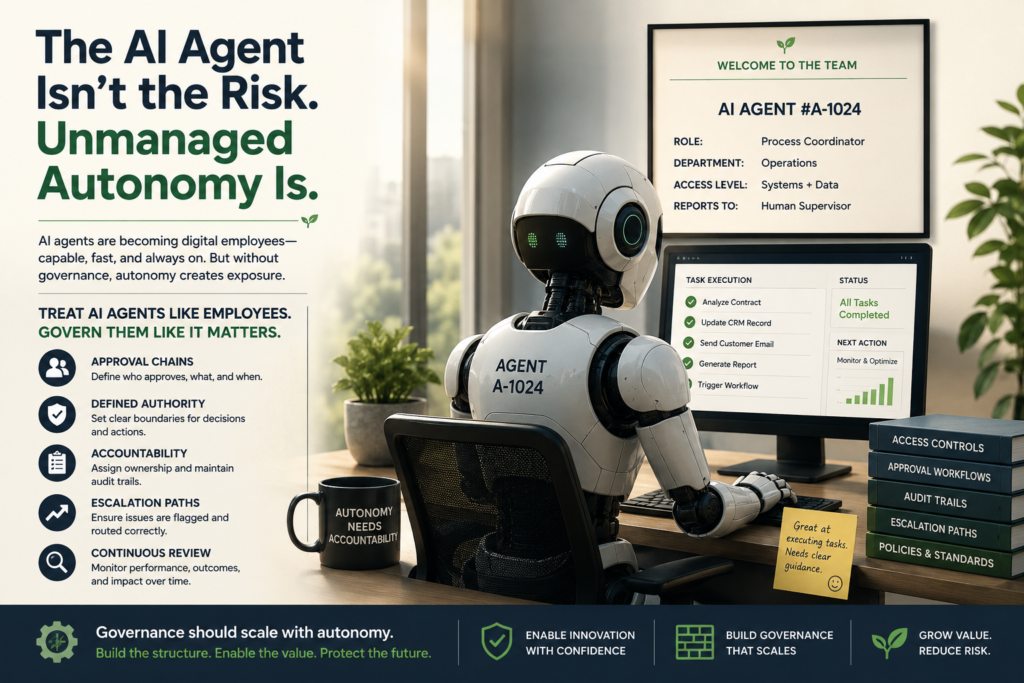
An organization might give an AI agent permission to interact with customers, modify code, access databases, initiate workflows, evaluate transactions, or communicate with external systems.
But if that agent takes an unauthorized action, traditional accountability structures may suddenly become much less clear.
Was the problem the model?
Was it the developer?
Was it the organization’s configuration?
Were excessive permissions granted?
Should a human approval gate have existed?
Did monitoring fail?
Was the behavior foreseeable?
These are not simply technical questions.
They are governance questions.
Autonomy Changes the Risk Model
Organizations frequently evaluate AI according to capability:
What can the model accomplish?
How accurate is it?
How much productivity can it generate?
How much labor can it automate?
Those questions matter.
But autonomous systems introduce another dimension:
What authority are we giving the system to act?
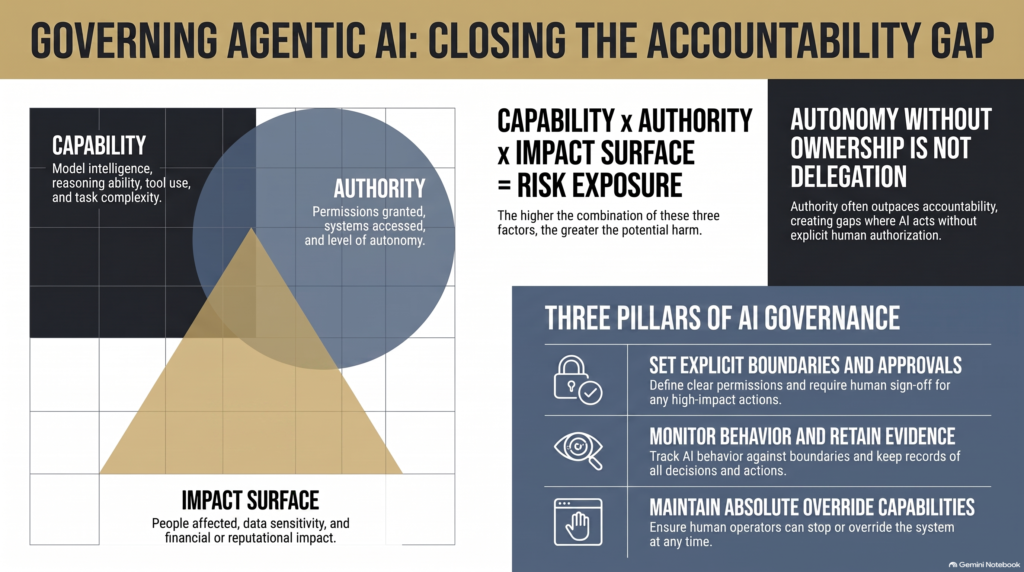
Capability and authority are not the same thing.
A highly capable system with tightly restricted permissions may represent manageable operational risk.
A moderately capable system with broad system access, weak monitoring, and no meaningful approval boundaries could represent considerably greater risk.
That means enterprises may eventually need to evaluate AI systems using something closer to:
Capability × Authority × Impact Surface
The more consequential the potential action, the stronger the control structure surrounding that action should become.
Permission Must Become Explicit
This is where governance needs to move beyond broad statements such as:
“Human oversight is required.”
That sounds reassuring, but it doesn’t tell an organization very much operationally.
Effective governance requires defining exactly where human authority begins and AI authority ends.
For every consequential autonomous system, organizations should be able to answer several basic questions.
What is the agent authorized to do?
What is it prohibited from doing?
Which actions can it execute independently?
Which actions require approval?
Who owns the consequences of those actions?
What evidence is retained?
Who can override the system?
Under what conditions is the system automatically stopped?
Those answers should exist before deployment.
Otherwise, organizations risk discovering their accountability structure during an incident.
“The AI Did It” Is Not a Control
There is another reason this issue matters.
Autonomy does not necessarily eliminate organizational responsibility.
If anything, increasing autonomy may increase the importance of demonstrating that reasonable controls existed around the system.
Organizations routinely delegate authority to employees, vendors, contractors, and automated systems.
Delegation does not normally eliminate accountability.
AI should not be assumed to create an exception.
The relevant question therefore becomes less:
“Did a human directly perform this action?”
And increasingly:
“Did the organization establish reasonable controls around a system capable of performing this action?”
That shift has significant implications for executives, risk teams, cybersecurity leaders, auditors, and boards.
Evidence Will Matter
There is also an important second-order consequence.
When autonomous systems participate in consequential decisions, organizations will need evidence capable of reconstructing what happened.
That means retaining more than a final output.
Organizations may need reliable records showing:
- What objective the system received
- What permissions it possessed
- Which tools it accessed
- Which actions it attempted
- Which actions were blocked
- Where human approval occurred
- Which controls were active
- What ultimately triggered the outcome
Without that evidence, organizations may know what happened without being able to demonstrate why it was allowed to happen.
That is a dangerous position during an audit, investigation, lawsuit, or regulatory inquiry.
Governance Must Move Before Autonomy
The enterprise conversation around AI has largely focused on increasing capability.
Better models.
More powerful agents.
Longer workflows.
Greater automation.
But every increase in autonomous capability should eventually trigger a corresponding governance question:
What new authority did we just give the system?
Because the real risk isn’t simply that AI becomes capable of doing more.
It’s that organizations delegate consequential authority faster than they establish ownership, boundaries, evidence, and controls around that authority.
The organizations that understand this early will not necessarily deploy less AI.
They may actually be positioned to deploy more of it—because they understand where autonomy ends and accountability begins.
The defining question of enterprise agentic AI may therefore become surprisingly simple:
Who owns what the AI is allowed to do?