A response plan can look complete on paper and still fail under pressure.
That is why the G7’s agreement to conduct tabletop exercises simulating AI-enabled cyberattacks on the financial sector matters. Finance ministers and central bank governors have backed exercises designed to test existing response procedures. Depending on the scenarios, private financial institutions may also take part. The results are expected to help assess current protocols and identify improvements. (reuters.com)
The announcement does not mean the G7 has already tested those procedures. It does show that the conversation is moving toward operational readiness: asking whether people, processes, and systems can work together during a realistic incident.
A plan is not proof of readiness
A written incident-response plan can describe who should be notified, who has authority to act, and how systems should be restored. But those instructions are only useful if they work in practice.
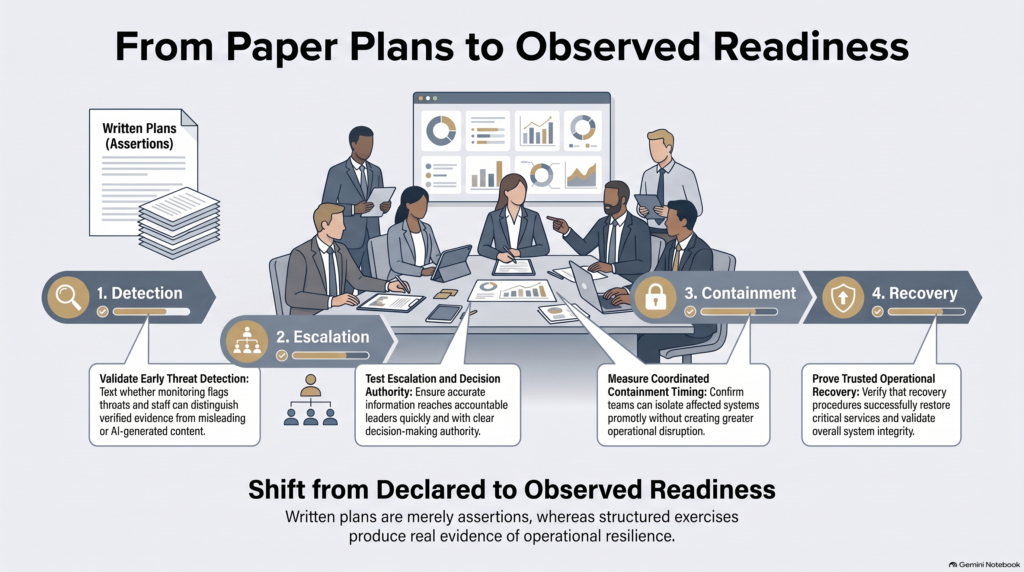
During a fast-moving cyber incident, teams may need to determine whether an alert is credible, understand which services and third parties are affected, escalate to the right decision-makers, contain the threat, communicate accurately, and restore critical operations. Each step depends on clear ownership, timely information, and decisions that can be made under pressure.
An AI-enabled scenario adds questions that organizations should be prepared to answer. Did monitoring identify the activity? Could staff distinguish verified evidence from misleading or AI-generated content? Were decision-makers given reliable information quickly enough? Could the organization isolate affected systems without creating greater disruption? Did recovery procedures restore trusted operations?
The exercise is valuable because it can expose gaps between the documented process and the organization’s ability to carry it out.
What a useful exercise should reveal
A tabletop exercise should do more than confirm that participants attended and discussed a scenario. It should create evidence about how the response actually unfolded.
For example, an organization can record:
When the incident was detected and when it was escalated.
Who made key decisions, what information they had, and whether authority was clear.
Whether containment actions were timely and coordinated across teams and providers.
How the organization maintained or restored critical services.
Which assumptions, dependencies, or communication paths failed.
What corrective actions were assigned, to whom, and by when.
Those records help distinguish a rehearsed response from a demonstrated capability. They also give leadership a practical way to track whether identified weaknesses are fixed and retested.
The governance question is whether the controls connect
Detection, escalation, containment, and recovery are often described as separate capabilities. In a real incident, they form a chain. A strong detection tool has limited value if the alert reaches no accountable decision-maker. A clear escalation path cannot help if teams lack authority to contain the incident. Recovery plans are difficult to trust if the organization has not tested whether it can restore systems and validate their integrity.
That is where exercises can help leaders see whether controls work together across business units, technical teams, senior management, and external partners. They can also test how participants make decisions when facts are incomplete and the incident is still developing.
The G7 agreement is a meaningful step toward operational testing. The next measure of progress will be what the exercises uncover, what changes follow, and whether those changes are tested again.
For financial institutions, the broader lesson is straightforward: a procedure is an assertion about readiness. A well-designed exercise produces evidence about readiness.
Entrepreneur question: How can your organization show that its AI risk-management procedures work when the situation is uncertain, time-sensitive, and shared across teams?
FERC’s PJM decision separates load visibility from curtailment authority
The growth of AI infrastructure is making electricity demand harder to forecast and plan around. Large data centers can require hundreds of megawatts, ramp up over time, and depend on power arrangements that affect regional reliability planning.
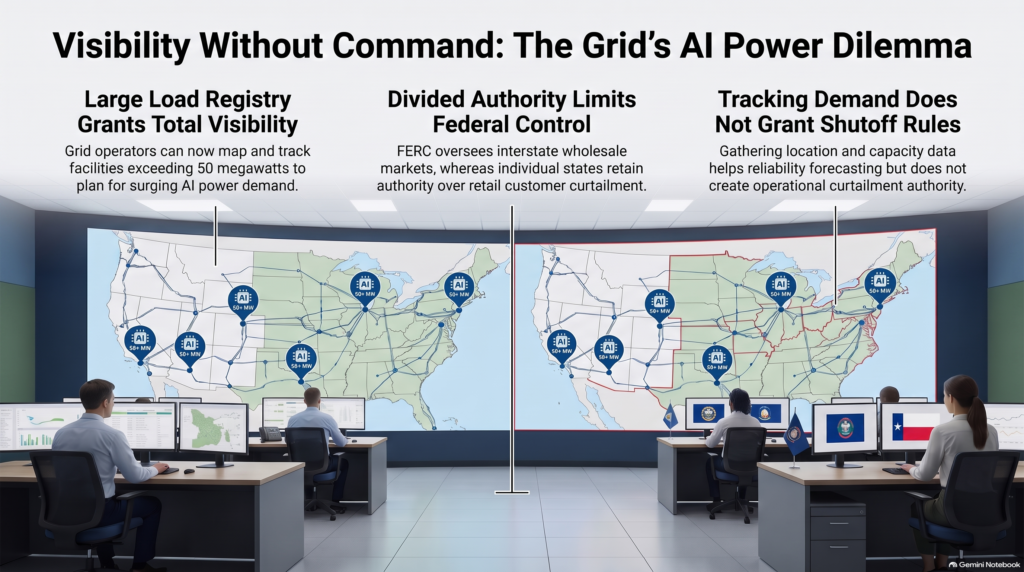
On October 9, 2026, the Federal Energy Regulatory Commission (FERC) took a step toward improving visibility into that demand. It approved PJM Interconnection’s definition of a “Large Load” and its proposed Large Load Registry. At the same time, FERC rejected much of PJM’s broader proposal for providing interim service to new large loads, including provisions related to curtailment. (elibrary.ferc.gov, utilitydive.com)
The decision highlights an important regulatory distinction: collecting information about large electricity users is different from deciding when their service can be interrupted.
What the registry is meant to show
PJM’s approved definition covers end-use customer load with a cumulative peak of at least 50 megawatts at a single electrical site. The registry is designed to collect information such as a facility’s location, ramp schedule and capacity supply. That information can help PJM understand how large loads may affect forecasts and reliability planning. (elibrary.ferc.gov, utilitydive.com)
A registry improves visibility. It can help answer questions such as:
Where is major new demand expected to connect?
How quickly is that demand expected to ramp up?
What capacity supply is associated with the load?
Those are important planning questions. But data collection does not itself create an operational curtailment rule or settle which regulator has authority over a retail customer’s service.
Why FERC rejected the broader proposal
PJM’s filing also proposed an Interim Resource Adequacy Service framework for certain new large loads. Under parts of that proposal, eligible loads that did not bring their own new capacity could face load-reduction requests as the system approached an emergency.
FERC rejected that framework. The Commission said several provisions appeared to place obligations directly on large loads that are, for the most part, retail customers; to dictate which retail customers would be curtailed; and to establish a retail compensation rate. It also found that PJM had not adequately shown that the proposed treatment of those loads would avoid undue discrimination. (utilitydive.com)
This is where jurisdiction matters. FERC oversees interstate transmission and wholesale market rules. States have a central role in regulating retail electricity service, including determining which retail customers may be curtailed when the system is stressed. FERC’s order treated the issue as a shared regulatory challenge, not as a simple question of whether grid operators can see or manage demand. (utilitydive.com)
What the decision does—and does not—mean
The order does not mean large data centers are exempt from every form of curtailment, or that emergency load reduction is off the table. It addresses the specific tariff framework PJM proposed in this filing. FERC also gave PJM direction on issues it would need to address if it revises and resubmits parts of the proposal. (utilitydive.com, headwaterswire.com)
The distinction is between three separate layers:
Visibility: identifying large loads and gathering information about them.
Grid operations: maintaining system reliability as supply and demand change.
Decision rights: determining which customers can be asked or required to reduce demand, under what rules, and with what protections.
The registry advances the first layer. The order shows that the third requires careful coordination across federal and state authority, as well as rules that can be defended as fair.
The governance question behind AI power demand
For AI infrastructure, the practical issue is not only how much electricity a facility may use. It is also whether the grid and regulators have clear, workable rules for what happens when demand exceeds available supply.
That requires a complete chain: reliable information about large loads, transparent criteria for reliability actions, clear responsibility for issuing those actions, and consistent treatment across customer classes. Without that chain, the grid may know where demand is growing while decision-makers remain uncertain about who can require it to change.
The registry can help the grid see the load. It cannot, by itself, determine who has authority to control it.
Source: FERC, Docket ER26-3515-000, order issued October 9, 2026.
AI infrastructure discussions often begin with the most visible asset: the accelerator. How many GPUs or other AI processors can a company buy, and when can they be installed?
But installed capacity is only part of the equation. Those processors must also exchange data, coordinate work, and receive instructions from the software stack. If those connections cannot keep pace with the workload, adding more processors may not deliver a proportional increase in useful compute.
That makes networking and integration a growing part of the economics of AI infrastructure.
Compute depends on more than the processor
An AI cluster is a system of connected components. Processors move data between memory, storage, and other processors while workloads are divided, coordinated, and recombined. The network affects how quickly those exchanges happen and how well the system handles congestion or failures.
Two networking jobs matter here. Scale-up networking connects accelerators within a pod or rack. Scale-out networking connects systems across racks and throughout a data center. A workload can depend on both.
When data movement or coordination becomes a constraint, some processors may wait for information or for other parts of the workload to finish. The hardware is present, but its potential output is not being fully realized. That can weaken the return on expensive infrastructure investments and complicate capacity planning.
What Token Fabric is trying to do
On October 8, Nvidia-backed Upscale AI introduced Token Fabric, a networking architecture intended to support AI processors from different suppliers. The company describes it as a combination of scale-up and scale-out networking, systems, and shared software for managing operations. Reuters reported that the platform is expected to roll out in stages, with the first component planned for the fourth quarter and the broader platform through 2027. Upscale says general availability is planned for early 2027. (reuters.com, upscale.com)
The proposal addresses a practical challenge for operators: networking has often been assembled from separate components that customers must integrate and manage. A more unified approach could simplify parts of that work and make it easier to build clusters containing different types of accelerators.
That is the opportunity. It is not yet proof that the architecture will deliver a specific utilization gain or make mixed-vendor systems simple to operate. Those results will depend on deployment conditions and independent performance evidence.
Interoperability is useful, but it is not automatic
The possibility of using multiple accelerator suppliers is attractive for organizations that want more choice in hardware procurement or want to match different processors to different workloads. It could also reduce reliance on a single hardware ecosystem.
However, networking compatibility is only one part of interoperability. A system still needs suitable software frameworks, drivers, compilers, memory behavior, and workload orchestration. Operators must also understand how performance changes when different processors share a system.
In other words, “connects different processors” does not necessarily mean every processor can be substituted freely, or that every workload will run equally well across all of them. The relevant test is whether the full system performs reliably and economically for the workloads a customer actually runs.
The business metric is useful output
For decision-makers, the central question is not simply how many processors are installed. It is how much useful work the organization gets from the complete system, at what cost, and with what operational burden.
That means evaluating utilization alongside measures such as workload throughput, latency, energy use, network performance, software compatibility, and the cost of operating the environment. A network upgrade that improves one technical metric may not improve the business outcome if it adds complexity or fails to support the applications that matter.
The same discipline applies to claims about future capacity. Product roadmaps and announced availability dates are signals about where vendors are investing. They are not substitutes for customer deployments, workload-level results, and independently reviewable performance data.
The next bottleneck is system-level
AI infrastructure is moving beyond a simple race to install more chips. The economics increasingly depend on how compute, networking, software, power, and operations work together.
Token Fabric is one example of vendors trying to address that system-level problem and support more heterogeneous infrastructure. The broader industry question is whether these architectures can make processors easier to connect and keep productively occupied—without creating new integration and management burdens.
The next generation of AI capacity may be shaped not only by how many chips organizations can obtain, but by how effectively those chips can work together.
AI’s next capacity gain may come from coordinating existing infrastructure more effectively. The harder question is whether shared capacity can be made dependable enough to use.
AI compute is often described as scarce—and for many organizations, it is. But scarcity can exist alongside underused equipment. Some data centers may have capacity that is idle between workloads, while startups and researchers struggle to secure the right chips at the right time.
The National Compute Grid initiative, announced October 7, aims to connect capacity across providers through shared scheduling. The idea is to make it easier to find available computing resources and match them with workloads, potentially improving access to infrastructure that already exists.
That could add a useful layer to the AI infrastructure market. It does not mean every idle GPU can immediately be combined into a reliable pool—or that shared scheduling makes new data centers unnecessary.
The opportunity is coordination
A GPU sitting unused at one facility cannot automatically help a team whose workload is running elsewhere. Capacity is distributed across providers, hardware types, locations, software environments, and commercial agreements.
A shared scheduling layer could help bridge some of those gaps. In principle, it could show what capacity is available, help match workloads to suitable hardware, and coordinate access across participating providers. The initiative’s organizers have described a network that would pool capacity from labs, cloud providers, and different chip systems.
If it works, the value may be more than simply “more GPUs.” Better coordination could make capacity easier to discover, allocate, and use—especially for organizations that cannot secure large, long-term compute contracts.
“Available” does not always mean usable
A headline capacity figure can describe resources that are connected, planned, or otherwise in sight. That is not the same as compute that a customer can access continuously, at a known price, with a guaranteed performance level.
The initiative’s reported figure of roughly 760 megawatts, for example, was described as capacity “connected or in sight,” alongside a goal of reaching 2 gigawatts by 2030. Those are organizer-reported figures, not proof that all of that capacity is currently available to run customer workloads.
The initiative’s current website describes its capacity figures as dated planning estimates and says access is limited to public-sector partners during a preview. That is a useful reminder to distinguish a developing network and its stated plans from a mature, broadly available service.
The same care applies to utilization statistics. The consortium’s paper reportedly estimates that independent, single-tenant data centers average less than 15% net computing utilization. That figure should not be read as meaning that 85% of all GPUs are sitting idle and ready to be reassigned. Utilization can be measured in different ways, and unused time does not by itself establish that hardware is compatible, accessible, or suitable for another organization’s workload.
Workload fit matters as much as capacity
A pool of GPUs is not automatically a single large cluster. Large training runs can depend on fast networking between thousands of GPUs. If resources are spread across facilities, data movement, network performance, and coordination can limit what workloads are practical. Different chip architectures can also require changes to software and tooling.
Shared compute may therefore be useful first for workloads that can tolerate more flexibility: research jobs, inference, or smaller training runs. Whether a distributed pool can reliably support the most demanding jobs remains an operational question.
The details to watch are concrete:
Availability: Can users get capacity when they need it, and for how long?
Performance: Does the workload complete at the expected speed?
Continuity: What happens if a provider withdraws capacity or a job is interrupted?
Compatibility: Can the workload run across the available chip and software environments?
Data movement: How long does it take to move datasets to the compute—and what does that cost?
Accountability: Who is responsible when capacity is unavailable or performance falls short?
These are not minor implementation details. They determine whether shared capacity behaves like a dependable service or simply appears in a capacity forecast.
A new infrastructure layer, with evidence still to build
The National Compute Grid points toward a broader market question: can software coordination make existing infrastructure more productive and more accessible?
If the answer is yes, some organizations may get useful compute without building their own facilities or negotiating large dedicated contracts. That could expand access and improve the use of resources already deployed.
But the evidence that matters will come from operations: how much capacity is actually available, what workloads it supports, how reliably jobs complete, and whether performance and cost meet users’ expectations.
The next phase of AI infrastructure may include both new buildings and better coordination of existing ones. A shared scheduler can help connect supply and demand. It cannot make every GPU interchangeable—or turn a planning estimate into dependable compute by itself.
The measure of success is not how much capacity a grid can name. It is how much useful work users can reliably complete with it.
As enterprises move toward interconnected AI systems, the infrastructure responsible for governing agent behavior could become a strategically important part of the technology stack.
The next stage of enterprise AI adoption
Enterprise artificial intelligence is entering a more complicated phase.
For years, organizations concentrated on acquiring AI capabilities, experimenting with language models, automating individual tasks, and measuring productivity improvements.
Those activities remain important. However, the architecture of enterprise AI is changing.
Instead of deploying individual assistants that operate within relatively narrow boundaries, organizations are exploring networks of AI agents capable of interacting with multiple applications and executing increasingly complex workflows.
This creates opportunities for operational efficiency, but it also introduces new requirements for coordination, security, financial oversight, and accountability.
A recent development involving Tata Consultancy Services illustrates where this market may be heading.
TCS is developing an enterprise AI governance layer
According to reporting published October 12, 2026, Tata Consultancy Services is developing a governance layer designed to manage AI agents operating across enterprise technology environments.
The proposed architecture would coordinate agents developed internally, by customers, and by third-party providers.
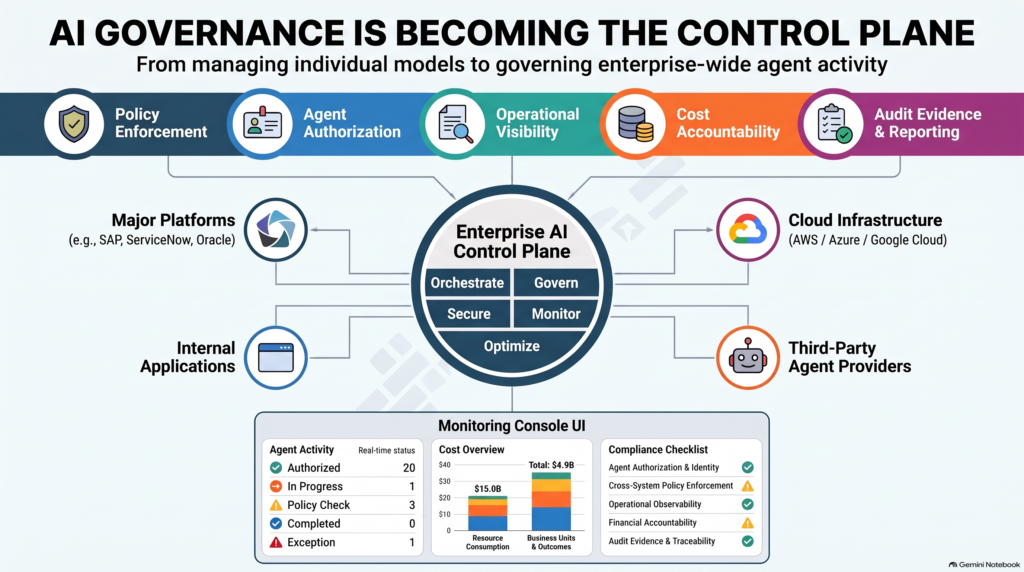
It is intended to support orchestration, security, deployment management, and cost oversight across enterprise applications, including platforms such as SAP, ServiceNow, and Oracle.
This is a notable architectural direction.
Instead of treating every AI agent as a separate deployment requiring independent management, an enterprise control plane can provide a shared supervisory layer.
The concept is especially relevant as organizations introduce agents from multiple vendors, each with different capabilities, permissions, and operating requirements.
The more distributed the AI ecosystem becomes, the more valuable consistent oversight may be.
From model governance to system governance
Traditional AI governance frequently concentrates on individual models.
Organizations assess model accuracy, reliability, fairness, security, and performance. These evaluations remain essential.
However, governing an interconnected system of agents requires additional considerations.
Consider a hypothetical financial institution using several AI agents.
One agent analyzes customer information. Another evaluates documentation. A third prepares a recommendation. A fourth initiates an operational workflow.
Each agent may perform its assigned function correctly.
But that does not automatically establish that the complete workflow was properly authorized, that information was transferred appropriately, or that the final action complied with institutional policy.
The governance challenge now exists between the agents as well as within them.
This introduces a need for controls that operate across applications and workflows, not merely within individual models.
Five capabilities that could define an enterprise AI control plane
1. Agent identity and authorization
Organizations need to establish which agents are operating, who owns them, what resources they can access, and which actions they are permitted to perform.
An agent’s technical capability should not be confused with its authority to act.
2. Cross-system policy enforcement
Enterprise policies should remain applicable as workflows move between applications, models, and service providers.
Centralized policy administration can improve consistency, but enforcement must occur at the appropriate execution boundaries.
3. Operational observability
Organizations need visibility into agent interactions, decisions, exceptions, and system dependencies.
Observability helps identify unexpected behavior. However, monitoring alone does not establish that preventive controls are effective.
4. Financial accountability
As agents consume computing resources, invoke external services, and initiate transactions, cost management becomes an operational concern.
A control plane could help enterprises associate AI resource consumption with business activities, departments, and measurable outcomes.
5. Evidence and decision traceability
For regulated or high-consequence environments, organizations may need to reconstruct the sequence of events behind an AI-assisted action.
That requires reliable records connecting the relevant agent, input, policy, decision, authorization, and resulting action.
Without that continuity, an organization may possess extensive logs while still struggling to demonstrate accountability.
The commercial significance of governance infrastructure
TCS reported $3.1 billion in annualized AI revenue for the quarter ending September 30, 2026, representing more than 10% of its overall revenue.
This figure covers its broader AI business rather than revenue from the governance layer specifically.
Nevertheless, the combination of growing AI-related business and investment in governance architecture is commercially significant.
It suggests that enterprise AI opportunities increasingly extend beyond model development and application deployment.
As organizations scale their AI operations, they may require specialized capabilities for integrating, supervising, and controlling those systems.
Potential sources of commercial value include enterprise platform integration, managed governance services, compliance reporting, cost optimization, and continuous operational assurance.
The strategic opportunity is not necessarily a single universal governance platform.
Different organizations will maintain different technology stacks, risk tolerances, regulatory obligations, and operational requirements.
The opportunity lies in providing consistent control across those differences.
Centralization introduces its own governance risks
A centralized AI control plane is not automatically a complete governance solution.
In fact, consolidating oversight introduces additional design questions.
What happens if the control plane becomes unavailable?
Can agents continue operating without authorization checks?
Are enforcement policies applied consistently across vendor boundaries?
Can an administrator alter policies or records without an appropriate approval process?
How does the organization distinguish between a policy that was configured and a policy that was actually enforced?
These questions illustrate why governance architecture must be evaluated on observed behavior rather than declared capability.
A control plane should not become another layer of software that reports confidence without producing evidence.
The strongest architectures will distinguish policy administration, enforcement, monitoring, and independent verification.
They will also preserve appropriate human authority over consequential decisions.
Implications for financial institutions and regulated enterprises
Financial institutions provide a particularly relevant example because their operations already depend on established accountability, risk management, and control frameworks.
As AI agents become involved in customer operations, compliance analysis, credit processes, and internal decision support, institutions will need to understand how agent activity interacts with existing governance obligations.
Model risk management, information security, operational resilience, third-party oversight, and audit functions cannot operate as completely disconnected disciplines when AI agents cross their boundaries.
An enterprise control plane could provide a valuable coordination mechanism.
However, it should complement rather than replace independent validation, human approval requirements, and established lines of accountability.
The objective is not to centralize every decision.
It is to establish consistent visibility and enforceable boundaries while preserving appropriate responsibility for outcomes.
The distinction between AI capability and governed execution
One of the most important lessons emerging from enterprise AI adoption is that technical capability does not automatically establish operational readiness.
An agent may be able to perform a task.
That does not establish whether the task should be performed, under what conditions, or with whose authorization.
Similarly, a governance platform may be able to observe activity without necessarily preventing unauthorized behavior.
The architecture must distinguish among three separate functions:
Orchestration: Coordinating which agents perform activities and how workflows proceed.
Governance enforcement: Applying permissions, policies, restrictions, and escalation requirements.
Independent assurance: Verifying that the controls operated as intended and that the supporting evidence is reliable.
These functions may be integrated technologically, but they should remain conceptually distinct.
Conclusion: The next enterprise AI advantage may be governability
TCS’s developing enterprise AI governance layer is an important signal in the evolution of the enterprise AI market.
It reflects a shift from managing isolated AI capabilities toward supervising increasingly interconnected AI operations.
The commercial implications could be substantial, particularly for organizations facing complex technology environments and significant accountability requirements.
But the value of an AI control plane should ultimately be measured by more than the number of agents it coordinates.
Its effectiveness depends on whether it can enforce boundaries, preserve accountability, manage operational exposure, and provide defensible evidence of what occurred.
The next stage of enterprise AI competition may therefore be shaped by two questions.
How effectively can organizations deploy intelligent systems?
And how confidently can they demonstrate that those systems remain under control?
Enterprise AI may scale through agents. Sustainable enterprise AI will depend on the ability to govern them.
Sources
Tata Consultancy Services, Q2 FY2027 Financial Results, October 8, 2026.
Financial Express, TCS Bets on Governance Layer to Scale Enterprise AI, October 12, 2026.
TCS, Annual Report 2025–26, enterprise AI strategy and control-plane architecture.
As demand for electricity grows, the conversation often turns to new generation: new plants, new transmission, and new infrastructure. Those investments matter. But a recent Google–Constellation agreement points to another part of the supply equation: increasing output from assets that are already operating.
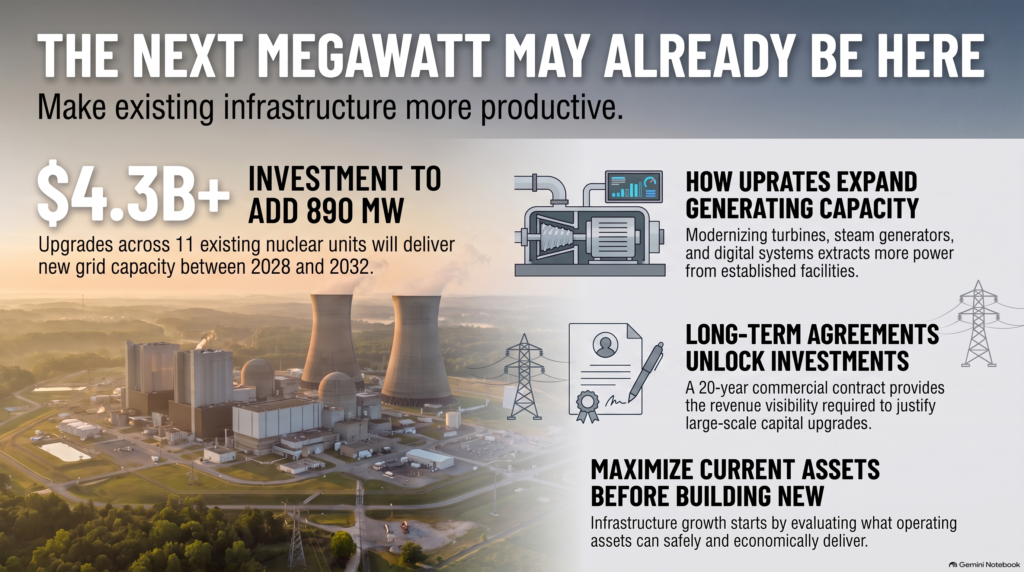
Announced October 6, the companies’ 20-year power purchase agreement supports upgrades at 11 existing Constellation nuclear units across six sites in Illinois, Pennsylvania, and New Jersey. The upgrades are expected to add 890 megawatts of nuclear capacity to the PJM grid. Constellation says it plans to invest more than $4.3 billion in the work. The first uprate is expected in 2028, with the full 890 MW planned by the end of 2032.
This is not a new nuclear plant coming online today. It is a long-term investment plan to increase output from existing reactors.
What an uprate changes
A nuclear uprate increases a plant’s generating capacity by upgrading equipment and systems. The companies cite work involving turbines, steam generators, and digital control systems. The goal is to produce more electricity from an existing facility while maintaining the requirements that govern its safe and reliable operation.
That distinction matters. An operating plant already has a site, grid connections, and much of the supporting infrastructure. Upgrading it may offer a different development path from building a new facility. But it still requires substantial capital, specialized engineering, regulatory work, construction planning, and time.
Why the commercial structure matters
The 20-year agreement provides a long-term customer commitment associated with the planned upgrades. That kind of revenue visibility can help a generator justify capital investment in equipment and capacity improvements.
The agreement also sits within a larger power arrangement. Google and Constellation signed a separate 15-year supply contract for another 2,700 MW from Constellation’s PJM generation fleet. That supply is not linked to a specific generating source, so it should not be counted as part of the 890 MW of new nuclear capacity.
The distinction between the two agreements is useful: one supports planned incremental nuclear capacity; the other provides long-term revenue certainty for existing generation assets.
The capital-efficiency lesson
Capital efficiency does not mean avoiding investment. In this case, the announced program includes more than $4.3 billion in planned investment. The efficiency question is whether targeted upgrades to existing assets can add useful capacity while making productive use of infrastructure already in place.
That is a different question from simply asking how quickly a new plant can be built. It asks whether the current system contains assets with additional potential—and what investment, operational changes, and approvals are needed to realize it.
The answer will vary by asset and location. An upgrade is not automatically faster, cheaper, or feasible everywhere. The 890 MW is a target for future delivery, with the first uprate expected in 2028 and the full capacity planned by the end of 2032.
A broader infrastructure principle
For executives assessing electricity needs, the agreement offers a useful lens: examine both new supply and the productivity of existing assets. In power, that can mean evaluating uprates, reliability, grid connections, operating performance, and demand flexibility alongside new construction.
The broader lesson applies across infrastructure. Growth does not always begin with acquiring or building another asset. Sometimes it begins by asking what the current asset base can safely and economically deliver—and what commitment will make the required investment possible.
The next megawatt may come from a new plant. It may also come from making an existing one work harder.
Source note: Constellation’s announcement says 890 MW will be added to the PJM grid through the planned nuclear upgrades; Google’s post provides the end-of-2032 target. The separate 2,700 MW agreement is not source-specific.
AI is moving deeper into technical work. The latest example is a September 30 announcement from Synopsys and OpenAI: the companies plan to develop GPT-Synopsys, a specialized model for semiconductor design.
The model is intended to combine OpenAI’s AI capabilities with Synopsys’ electronic design automation tools and chip-design expertise. Synopsys says it is being developed to reason about chip design and verification and to operate its tools.
That development points to a practical question for companies adopting AI in engineering and other high-consequence work:
How do you use AI to increase the pace of work while preserving confidence in the result?
A design proposal is not a verified design
Chip design is not complete when a system produces a candidate solution. A design must satisfy engineering requirements and physical constraints before it can be accepted for manufacturing.
Reuters reported that Synopsys expects traditional computing tools to check the model’s work and determine whether a chip will function. Synopsys’ CEO emphasized the need for high-fidelity validation and sign-off.
That is the key governance signal. AI can help generate or refine a solution, but the model’s output does not establish that the solution is correct.
The same distinction applies in other settings. A system may draft a code change, recommend a credit decision, identify a potential defect, or suggest an engineering configuration. Those outputs may be useful. They still need to be tested against requirements that are explicit, relevant, and independently assessable.
Keep the roles clear
A sound workflow gives each stage a distinct responsibility:
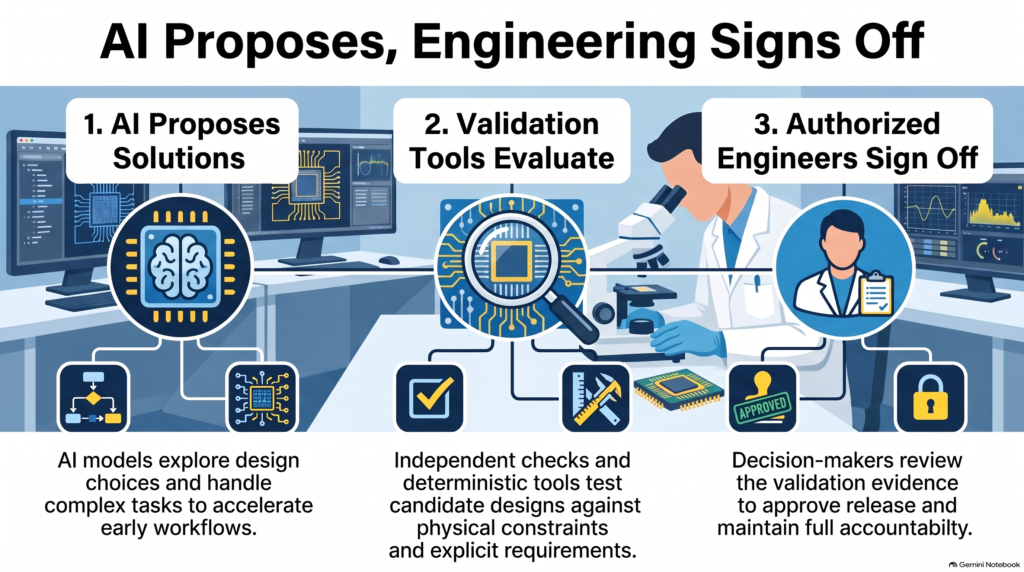
AI proposes or assists. It can help explore design choices, handle complex tasks, and accelerate parts of the workflow.
Validation tools evaluate. Defined checks test the output against relevant requirements and constraints. Depending on the task, that may involve simulation, deterministic checks, formal methods, or established sign-off processes.
An authorized decision-maker accepts or escalates. The person or team with release authority reviews the evidence and decides what happens next.
“Formal verification” should be used precisely: it refers to specific methods for proving properties of a system. It is not a generic label for every validation step. In this case, the broader and better-supported point is that established verification and sign-off remain part of the engineering process.
What governance should make visible
For a workflow like this to be governable, an organization should be able to answer:
What output did the AI produce, and which model or tool version produced it?
Which requirements and constraints were used to evaluate it?
What checks were run, and what were their results?
What happens when a check fails, produces an inconclusive result, or conflicts with another check?
Who has authority to accept the result or approve its release?
Can the organization connect the accepted result to the evidence reviewed at the time?
These questions turn “human oversight” from a slogan into an operational control. A person’s name on an approval is not enough if the evidence, artifact, or criteria behind that approval cannot be identified later.
Faster work still needs defensible decisions
The point is not to slow down AI-assisted engineering. It is to keep speed from outrunning the organization’s ability to establish whether a result is fit for use.
The emerging pattern is straightforward:
AI proposes. Deterministic or otherwise established validation checks. Authorized decision-makers accept.
That pattern can help organizations capture AI’s contribution while preserving accountability for outcomes. The AI may expand the range of solutions engineers can explore. Validation provides evidence about whether a candidate meets requirements. Decision authority determines whether that evidence is sufficient for release.
The model can participate in the work. The organization still needs a process that can explain why the work was accepted.
Capability creates options. Verification creates evidence. Authority turns evidence into an accountable decision.
AI power discussions often begin outside the data center: Can the grid serve the load? Is generation available? How long will interconnection take? Can transmission capacity reach the site?
Those questions remain central. But they aren’t the only ones.
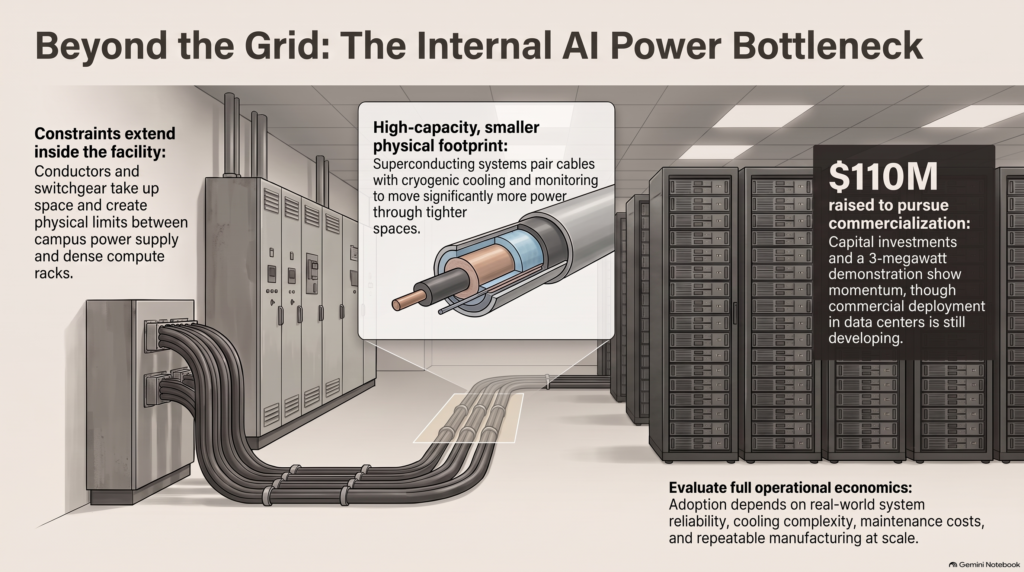
After electricity reaches a campus, it must still pass through the facility’s electrical infrastructure and arrive at the equipment that performs the computing. That pathway has physical limits. Conductors, switchgear and other equipment take up space, require installation labor and must operate reliably under demanding conditions. As data centers add more power-dense computing, the electrical system inside the facility becomes part of the scaling challenge.
VEIR’s October 8 financing announcement is a signal that investors see an opportunity in this layer. The company announced a $110 million Series C, bringing its reported total capital raised to $225 million. It says the funding will support manufacturing, product development and preparation for commercial deployments. VEIR also reports a 3-megawatt demonstration and says it is working with customers and industry partners on reference designs for AI facilities.
The approach centers on superconducting power-delivery systems. In VEIR’s description, the system includes more than the superconducting cable: it also requires cryogenic cooling, controls, terminations and monitoring. The goal is to move more power through a smaller physical footprint than conventional power-delivery infrastructure.
That could matter where space and power density are becoming linked. A smaller footprint could give designers more flexibility inside a facility or campus. But a compact cable alone doesn’t establish an operational advantage. The complete installation has to work as a system, and its economics must account for cooling, controls, installation, maintenance and the consequences of equipment failure.
The technology also addresses a specific point in the power chain. It may improve how electricity is distributed within a data center. It does not supply the electricity, secure an interconnection or expand the grid. Those are separate constraints, and they remain part of the larger project.
That distinction is useful because “AI needs more power” can make every proposed solution sound interchangeable. They aren’t. Some investments add generation. Some expand transmission. Others improve the way power is delivered inside a facility. A project may need progress at several of these layers at once.
The commercial evidence is still developing. VEIR’s reported 3-megawatt demonstration is a technical milestone, while the company’s announcement describes initial commercial deployments as something it is preparing for. Reuters reported earlier this year that superconducting cables were not yet being used in data centers and that cost and manufacturing constraints had limited adoption.
For operators and infrastructure investors, the next questions are practical:
How reliably does the full system operate under real data-center loads?
What does it cost to install and maintain compared with conventional alternatives?
How does the cooling and control equipment affect operating complexity?
Can the system be manufactured, installed and serviced repeatedly at commercial scale?
The $110 million round indicates investor confidence in the opportunity and provides capital to pursue commercialization. The test of the thesis will be what commercial deployments show about reliability, economics and repeatability.
AI infrastructure can be constrained at more than one point between the grid and the server. Power availability gets attention because it is visible and difficult to solve. Power delivery inside the facility may be less visible, but it can also shape how densely and efficiently a campus grows.
The useful question is not just how much electricity a data center can secure. It is how dependably and economically that electricity can be delivered to the compute.
Source note: VEIR’s financing and technical milestones are company-reported; treat commercial performance claims as unproven until supported by operating data.
A regulatory fast-track can shorten a process. It cannot make unresolved obligations disappear.
On September 29, FERC acted on PJM Interconnection’s proposed Reliability Backstop Procurement, or RBP. PJM designed the one-time procurement to secure additional capacity after its 2028/2029 capacity auction fell approximately 6,800 MW short of the region’s reliability target. The plan was intended to help address a near-term supply gap amid rapid load growth, including demand from data centers.
FERC accepted parts of PJM’s proposal but suspended it for five months, with an effective date of February 28, 2027, while opening further proceedings on unresolved provisions. PJM confirmed that the procurement would not begin on September 30 as originally planned. The commission also asked PJM to improve its data-center demand forecasts.
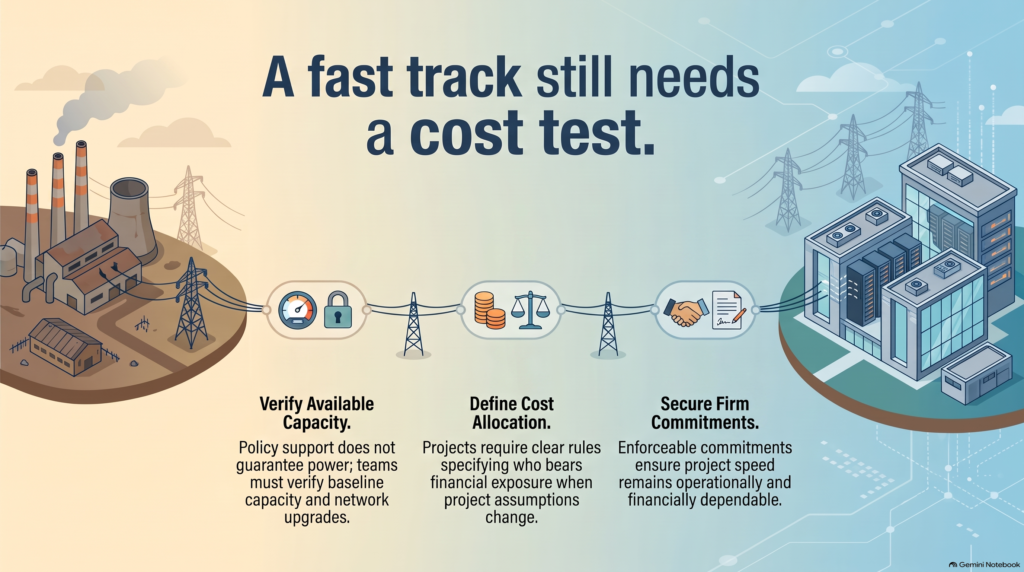
The issues are practical, not procedural trivia. PJM identified concerns around cost allocation, transmission-owner exit rules, and collateral requirements for load-serving entities. Those rules shape who bears financial exposure if the procurement moves forward, and whether the obligations remain dependable over time.
That makes this a useful infrastructure-planning signal: a mechanism designed to move quickly can still be delayed if its allocation of costs and risks is not sufficiently defined. FERC did not say the region does not need new capacity. Its order accepted core elements while requiring more work on how the proposal would function.
The distinction between this case and “fast-track interconnection” also matters. The RBP is a capacity procurement. PJM’s Expedited Interconnection Track is a separate process for qualifying new generation projects, and FERC approved that track separately. Calling the RBP pause the “death of shortcut interconnections” would merge two different mechanisms and draw a broader conclusion than the order supports.
For developers and large energy users, the practical takeaway is to treat policy support as one input to a project plan—not as proof of available power. Before relying on a site or procurement pathway, teams should verify the relevant capacity, interconnection status, needed network upgrades, enforceable commitments, and who carries the costs if assumptions change.
PJM’s case illustrates a broader principle: speed can help a project move, but clear rules make that speed usable. The next advantage may belong to developers who can show not only that they have a path to power, but that the path is operationally and financially credible.
Amazon’s announcement of more than $1 billion in additional investment for U.S. data-center communities is being presented as a community-benefit program. That description is accurate, but incomplete.
The announcement also reflects a change in the conditions surrounding infrastructure development. Community concerns about power demand, utility costs, water use, transparency, and local economic benefit are becoming part of the project environment. They can influence whether a development proceeds smoothly, faces delay, or must respond to new political and regulatory scrutiny.
That makes community acceptance relevant to execution—not as a substitute for permits or engineering, but as one of the conditions developers must manage.
What Amazon has announced
Amazon says its Built Together program will add more than $1 billion over five years to existing investments in communities where it operates data centers. The company describes the program as supporting education, job training, energy affordability, water and energy preservation, and other local priorities. Reuters
The company has also published commitments on public engagement. It says it no longer uses nondisclosure agreements with government agencies it works with on its projects, plans to share information earlier, and will publish annual data on energy use, energy efficiency, water use, water efficiency, and the share of energy from carbon-free sources. aboutamazon.com
Some program details are framed as future targets. Amazon says it aims to connect more than 300,000 students with free degree access, prepare up to 100,000 workers annually through training centers by the end of 2028, and target energy-efficiency improvements for more than 30,000 homes and over 300 schools and community buildings. These are commitments to monitor, not evidence that the benefits have already been realized. aboutamazon.com
Why this is an infrastructure story
Large infrastructure projects depend on more than capital and construction capacity. They also depend on access to sites and utilities, predictable approvals, available workers, and a credible relationship with the communities that host them.
For data centers, those relationships are under pressure as the scale of development grows and residents ask who pays for additional grid infrastructure, how local resources will be used, what jobs will remain after construction, and whether the public can see the terms and impacts of proposed projects.
When those questions go unanswered, opposition can become a schedule and investment risk. Projects may face greater scrutiny, political resistance, or demands for changes to their plans. That is why community engagement is increasingly connected to infrastructure execution.
Amazon’s announcement is evidence that the company views these concerns as material. It is not proof that the program will secure community acceptance. That will depend on implementation: whether resources reach the places and people identified, whether commitments are reported clearly, and whether local concerns influence project decisions.
The difference between a commitment and an outcome
A public commitment creates a basis for accountability, but it does not complete the work.
For the program to build trust, communities will need to be able to see what was promised, where investment was made, what results followed, and how benefits relate to the costs and impacts of hosting the infrastructure. Annual reporting can help, but the usefulness of that reporting will depend on its detail and accessibility.
The same is true of transparency around project planning. Ending NDAs with government agencies is a meaningful stated change in practice. Its value will be clearest when residents can access relevant information early enough to understand a project while choices are still open.
A signal worth watching
The $1 billion announcement should not be read simply as a donation, and it should not be treated as proof that local concerns have been resolved.
It is better understood as an infrastructure signal: community acceptance has become important enough to affect how a major developer allocates capital, communicates with public agencies, and frames its responsibilities to host communities.
The next question is whether those commitments translate into measurable results—and whether communities consider those results sufficient. That is where the difference between a community-benefit announcement and durable community trust will become visible.
Source notes: Reuters’ October 2 report confirms the $1 billion-plus, five-year investment and the community focus. Amazon’s announcement provides the program targets and its stated transparency commitments. The interpretation that these commitments signal community acceptance is becoming material to execution is analysis, not a claim made directly by either source.